Transistor Packages, Lead Identification and Testing

  • Name the different package styles of bipolar transistors?

    Most commonly used transistor package styles include the TO-5, TO-18, TO-39, TO-72, TO-237, TO-92, TO-3, TO-66 and TO-220 packages. Transistors in TO-3 and TO-66 packages are high-power devices, while those with small metal can or plastic body (TO-5, TO-18, TO-39, TO-72, TO-237, TO-92, TO-220) are low- to medium-power devices. Transistor leads are made of gold, aluminum or nickel and then encapsulated in a container.
  • Draw the lead arrangement for different transistor package styles?

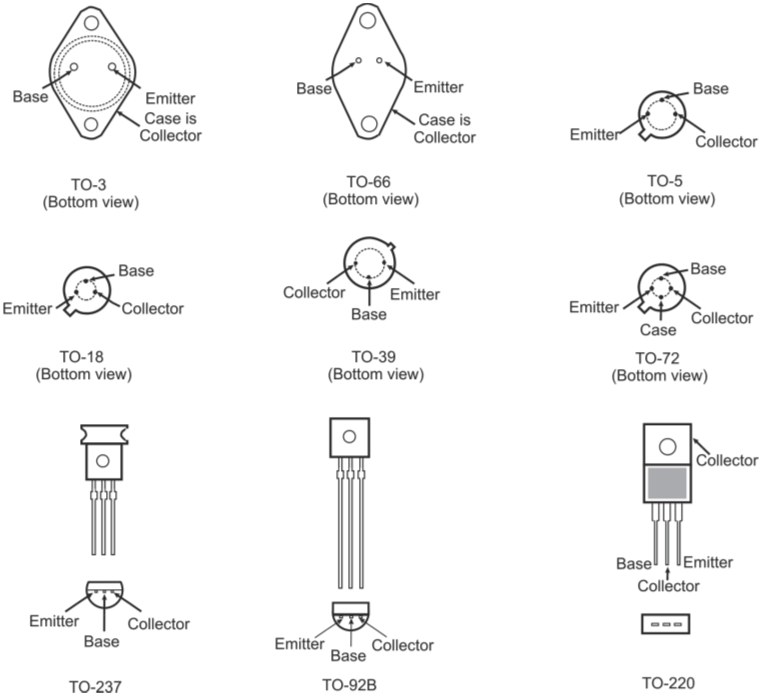
    Figure below shows the different package styles and their lead arrangement. Please take note of the following points
    1. Metal can transistor packages (TO-5, TO-18, TO-39) invariably have a notch and the lead adjacent to the notch is the emitter. Starting from the emitter and moving clockwise, the leads are identified as emitter–base–collector.
    2. In metal packages, the lead that is common to the metal body is the collector.
    3. In some of the plastic packages like TO-106 for instance, there is a dot near the emitter lead.
    4. The lead arrangements of TO-66 and TO-3 package styles are identical when both types are viewed in the same way. The metal body in both these types is the collector and there is no separate lead for the collector.
    5. Transistors with TO-72 package have four leads with the fourth lead connected to the case internally. The package has a notch near the emitter lead and the leads are identified as emitter–base–collector starting from the emitter and moving clockwise just like other similar packages with a notch but having three leads.
    6. Another widely used package designation for the transistors is the ‘SOT’ designation. It has much larger number of package styles than the popular ‘TO’ designation. Please remember that for most of the popular transistor numbers there is a corresponding ‘TO’ designation for a given ‘SOT’ designation and vice versa. For example, SOT-18 and TO-72, SOT-54 and TO-92 packages are the same. Some popular SOT packages that are only a slight variation of the popular TO packages. As an example, SOT-93 is similar to TO-220 but with a slightly larger width. Lead identification for a given SOT package is the same as that for the corresponding TO package.

    Transistor package styles and lead identification

  • How can we identify the leads of a transistor using a multimeter?

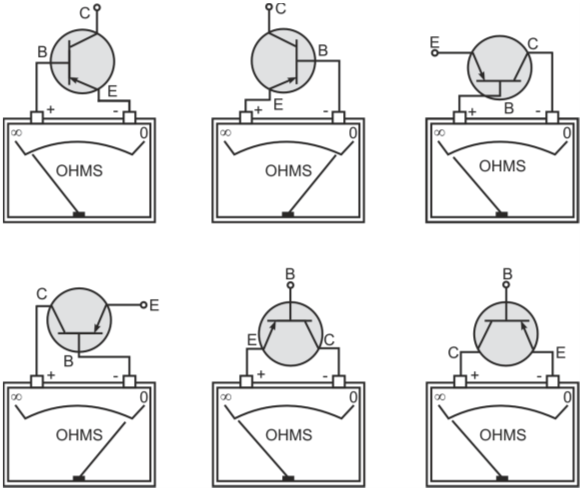
    The procedure for identifying the leads of a healthy transistor is the same as that for PN junction diodes. The base–collector and base–emitter junctions can be checked with the multimeter to identify the leads. In the multimeter identification of transistor leads, if either the collector or the emitter lead is known, the other two leads can be identified without any problem from a single junction test. The multimeter tests for identifying the leads of a bipolar junction transistor are illustrated in Figure below for an NPN transistor.

    Lead identification of NPN transistors using a multimeter

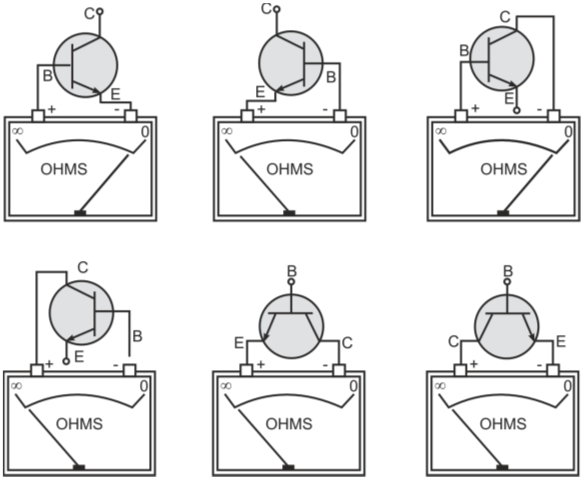
    Figure below shows the lead identification process of a PNP transistor using a multimeter.

    Lead identification of PNP transistors testing using a multimeter

  • How can we test a transistor?

    We can test a transistor in the following different ways.
    • Transistors can be checked using a multimeter, an ohmmeter and a curve tracer.
    • Using a multimeter, transistors are tested by checking the base–emitter and collector–base junctions both in the forward-biased and reverse-biased modes in the same fashion as explained in the case of the PN junction diode.
    • In addition, collector–emitter terminals should show an open condition in both the directions.
    • Advanced digital meters provide the value of hFE by placing the transistor in the socket provided for the purpose.
    • Transistors can be checked using an ohmmeter or the resistance scale of digital multimeters. With the collector open, forward-biasing the base–emitter junction should show a low resistance and reverse-biasing the base–emitter junction should show an open condition. Similarly, with emitter open, the base–collector junction can be checked.
    • Curve tracer can be used for comprehensive testing of transistors as it can be used to display the input and output characteristics of a transistor. The value of transistor  or hFE can be calculated from these curves.

Got a voltage spike of curiosity?

Send your doubts now!