Class B Amplifiers

  • What are Class B amplifiers?

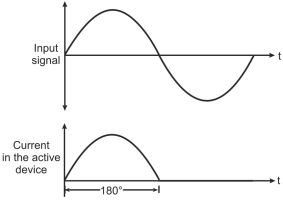
    In a class B amplifier, the active device is biased at zero DC level. Therefore, it provides an output signal varying over one-half of the input signal cycle as the active device conducts for only one-half of the input signal cycle (refer to figure below).

    Waveforms of class B amplifiers

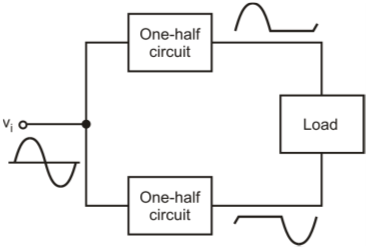
    To obtain output for full input cycle, push–pull configuration is used, that is, two active devices are used wherein each conduct for opposite half-cycles and the combined operation provides full cycle of the output signal. Figure below shows the block schematic of a push–pull configuration.

    Block schematic of push–pull configuration

  • What is the main advantage of Class B amplifiers?

    Class B amplifiers offer much improved efficiency over class A amplifiers with a possible theoretical maximum of 78.5%. Class B amplifier offers higher power output and there is negligible power loss under quiescent conditions, that is, when no input signal is applied.

  • What is the main disadvantage of class B amplifiers?

    Class B amplifiers create a large amount of harmonic distortion, self-bias configuration cannot be used and power supply voltages must have good regulation.

  • What are different configurations of class B amplifiers?

    Different circuit arrangements of class B amplifiers are as follows.
    • Transformer-coupled push–pull configuration
    • Complementary-symmetry push–pull configuration
    • Quasi-complementary push–pull configuration

  • Draw the circuit of a transformer-coupled push–pull class B amplifier?

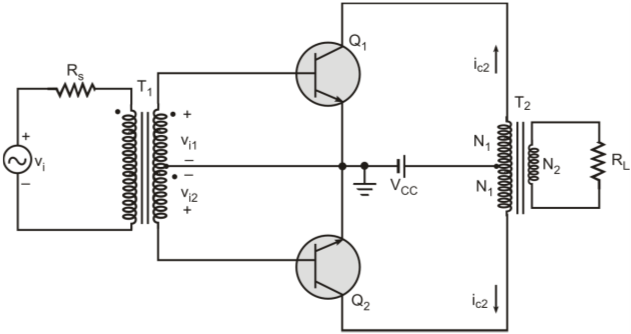
    Transformer-coupled push-pull class B amplifier is essentially the same as a push–pull class A amplifier except that the active devices in this case are biased in the cut-off region. Figure below shows the circuit of a transformer-coupled push-pull amplifier.

    Transformer-coupled push–pull class B amplifier

  • How is the circuit of a transformer-coupled push–pull class B amplifier different from the circuit of a transformer-coupled push-pull class A amplifier?

    Class B push-pull amplifier has R2 = 0, as silicon transistor, is essentially in the cut-off region if its base terminal is shorted to the emitter terminal.

  • Determine the conversion efficiency of a transformer-coupled push-pull class B amplifier?

    Let us assume that the output characteristics of the active device are equally spaced and also that the minimum collector current is zero. Figure below shows the graphical schematic for determining the output waveform of a single class B transistor stage. As we can see that for a sinusoidal input excitation, the output is sinusoidal during the first half of the input cycle and is zero during the second half cycle.
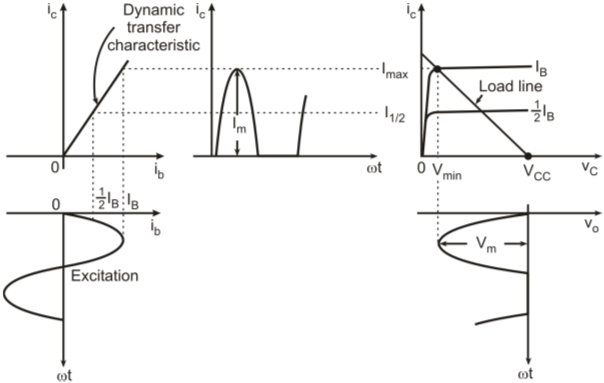
    Output waveform of a single class B transistor stage

    Where,
    N1 is the number of primary turns to the center tap
    N2 is the number of secondary turns
    Figure below shows that the collector current waveforms of transistors Q1 and Q2.
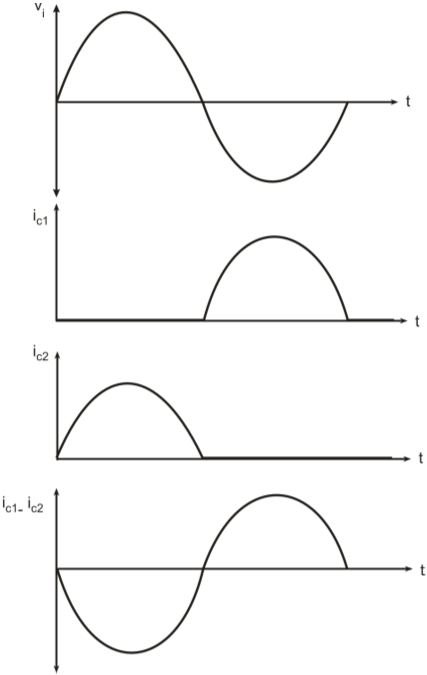
    Output waveforms for class B push–pull amplifiers

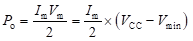
    As is clear from the figure, the output waveform of transistor Q2 is 1800 out-of-phase to that of transistor Q1. The load current is proportional to the difference between the collector currents flowing through the transistors Q1 and Q2. It is therefore a perfect sine wave for ideal conditions. The output power (Po) is given by

    The maximum power (Po(max)) that can be delivered to the load occurs for the conditions Vm = VCC, Vmin = 0 and the operating point is at the center of the output characteristics of the transistor. The value of Po(max) is given by

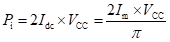
    The DC input power (Pi) from the supply is given by

    Where,
    Idc is the DC value of the input current The factor of 2 arises because the two transistors are used in push–pull configuration. The efficiency of the circuit is given by

    Therefore,

    The efficiency is maximum when Vmin = 0. The maximum possible conversion efficiency is equal to 25π which is equal to 78.5%. For practical systems, the efficiency achieved is not as high as 78.5% but the value of efficiency is higher in systems where the minimum value of the input signal is much less than the supply voltage (i.e., Vmin << VCC).

  • Write the expression for power dissipated in a class B amplifier?

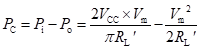
    The collector dissipation in both the transistors (PC) is the difference between the input power to the collector circuit and the power delivered to the load.

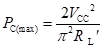
    When Vm = 0, PC = 0. As Vm increases, the value of the power dissipated in the transistors (PC) increases and it is maximum for Vm = 2VCC/π. The peak value of power dissipation in both the transistors (PC(max)) is given by

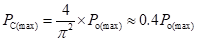
    Therefore,

    Hence, we can obtain a power output of five times the specified power dissipation of a single transistor. As an example, to deliver 10 W from a class B push–pull amplifier, the transistors should have a collector dissipation of 2 W each.

  • Why do class B amplifiers offer better efficiency than class A amplifiers?

    Class B systems offer higher efficiency as no current flows in a class B amplifier when there is no input signal excitation whereas there is a quiescent current flowing through the active device in a class A amplifier in the absence of input signal. Dissipation in class B amplifiers is zero in the absence of input signal and it increases with excitation. For a class A amplifier, dissipation is maximum at zero input and decreases as the signal increases.

  • List different harmonic distortion components for a push-pull class B amplifier?

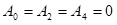
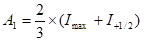
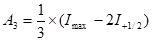
    The output of a push–pull system has a mirror symmetry. Therefore, IQ = 0, Imax = –Imin and I+1/2 = –I–1/2. Values of different harmonic distortion components are given by

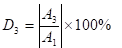
    Therefore, there is no even-harmonic distortion. The principal contributor to the harmonic distortion is the third harmonic distortion component (D3) given by

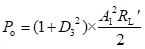
    The total output power (Po), taking harmonic distortion into account, is given by

  • What are complementary-symmetry push–pull class B amplifiers?

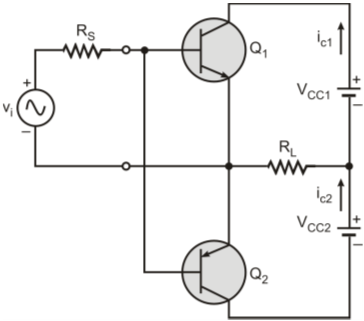
    Complementary-symmetry push–pull class B amplifiers make use of complementary transistors (NPN and PNP) to obtain a full-cycle output across the load with each transistor operating for half cycle. They dispense with the input and the output transformers. The NPN transistor is so biased that it conducts during the positive half of the input signal whereas the PNP transistor conducts during the negative half of the input signal. The same input is applied to the base terminals of both the transistors. The output appears across the load for the full cycle of the input signal.

  • Draw the circuit diagram of a complementary-symmetry push-pull class B amplifier?

    Figure below shows the circuit diagram of a complementary-symmetry push-pull class B amplifier.

    Complementary-symmetry push–pull class B amplifier

  • What are the drawbacks of complementary-symmetry push-pull class B amplifier?

    There are two main drawbacks of this configuration.
    • It requires two different voltage supplies.
    • The output signal suffers from crossover distortion as the transistors conduct partially near the zero-voltage condition.

  • Which type of complementary-symmetry push-pull class B amplifier is used in practice?

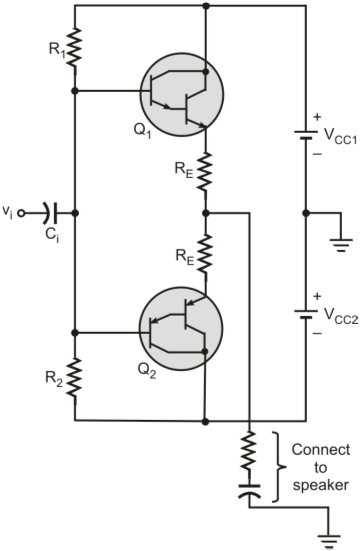
    Practical version of a complementary-symmetry push–pull class B amplifier is the one employing Darlington-connected transistors as shown in figure below. The circuit offers higher output current capability and lower output resistance.

    Complementary-symmetry push–pull class B amplifier with Darlington transistors

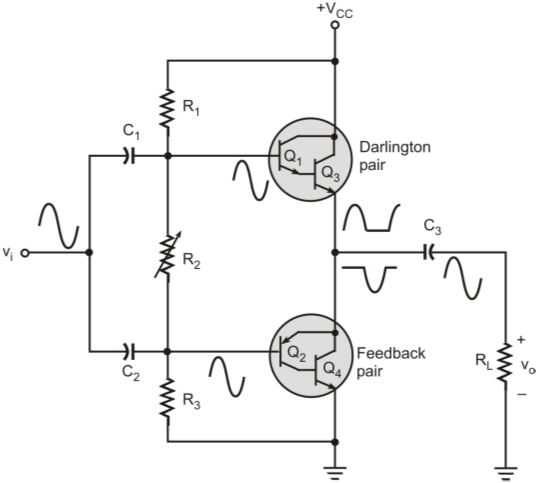
  • Draw the circuit diagram of a quasi-complementary push–pull class B amplifier?

    Figure below shows a quasi-complementary class B amplifier.

    Quasi-complementary-symmetry push–pull class B amplifier

    The push–pull operation is achieved by using a pair of complementary transistors. Transistors Q1 and Q3 form a darlington connection that provides output from a low-impedance emitter follower. Transistors Q2 and Q4 form a feedback pair and they provide a low-impedance drive to the load. The crossover distortion can be minimized by adjusting the value of the resistor R2.

  • Why is quasi-complementary push–pull amplifier is the most popular form of power amplifiers?

    Quasi-complementary push-pull amplifiers offer many advantages. One of the main advantages of using the quasi-complementary configuration is that it employs matched NPN transistors as high current devices and does not require a high-power PNP transistor as required in case of complementary-symmetry amplifiers.

Got a voltage spike of curiosity?

Send your doubts now!