Voltage Controlled Oscillators

  • What are Voltage-Controlled Oscillators?

    A voltage-controlled oscillator (VCO) is an oscillator circuit in which the frequency of oscillations can be varied by an applied DC control voltage. This is achieved by having a voltage-dependent capacitor commonly known as varicap or a varactor diode as a part of the frequency-determining tank circuit.
  • Which oscillator configurations are best suited for building VCOs and why?

    Hartley and Clapp oscillator configurations are particularly suited to building VCOs as in both cases, the frequency-determining LC circuit has a single capacitor and tuning can be easily done by replacing this capacitor by a varactor diode.

  • Draw the circuit of a VCO Hartley oscillator?

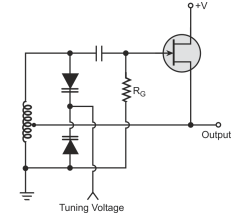
    Figure below shows the basic voltage-controlled Hartley oscillator configured around a junction FET.

    Voltage-controlled Hartley oscillator

    The amplifier is configured as common-drain amplifier with voltage gain slightly less than unity. In this case, the feedback factor is greater than 1 as the output signal appears across portion of the coil between source terminal and ground and the feedback signal appears across the whole of the coil winding. A similar circuit could be configured around a bipolar transistor also.

  • Why a single varactor diode is not used in VCO?

    Single varactor diode is usually not used in VCOs because of the reason that for small values of DC control voltages, the varactor diode may start conducting at either of the peaks of the RF signal depending upon how it is connected in the circuit. Conducting diode reduces the Q-factor of the tank circuit and deteriorates the phase noise performance. Back-to-back connection of two varactor diodes overcomes this problem.

Got a voltage spike of curiosity?

Send your doubts now!