Thyristor Performance Parameters

  • List the major performance parameters of a thyristor?

    Major performance specifications of a thyristor are listed below • Repetitive peak reverse voltage, VRRM • Non-repetitive peak reverse voltage, VRSM • Repetitive peak OFF-state voltage, VDRM • Break-over voltage, VBO • Critical rate of rise of ON-state current (di/dt) • Critical rate of rise of OFF-state voltage (dv/dt) • Holding current, IH • Holding voltage, VH • Latching current, IL • I2t rating Figure below shows the V-I characteristics of a thyristor listing various performance parameters of a thyristor.
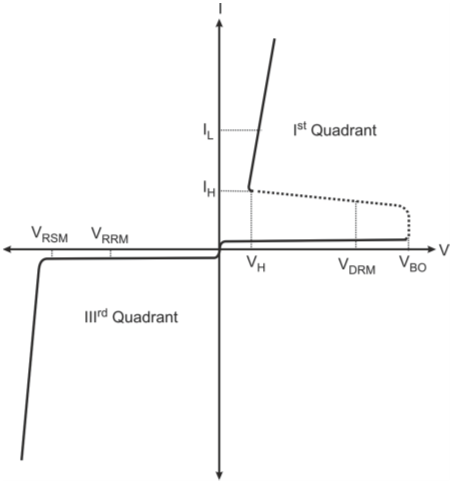
    Thyristor parameters

  • What is repetitive peak reverse voltage parameter of a thyristor?

    Repetitive peak reverse voltage (VRRM) is defined for reverse-blocking mode of thyristors like SCRs for operation in the third quadrant of the V-I characteristics. It is the maximum repetitive reverse voltage (anode negative with respect to the cathode) that can be applied to the device safely while still keeping it in the blocked state. The current that flows through the device in this state is referred to as the repetitive peak reverse current (IRRM).

  • What is non-repetitive peak reverse voltage of a thyristor?

    Non-repetitive peak reverse voltage is also defined in a similar way as for repetitive peak reverse voltage. Non-repetitive peak reverse voltage rating of a thyristor is a little higher than repetitive peak reverse voltage.

  • What is repetitive peak OFF-state voltage of a thyristor?

    Repetitive peak OFF-state voltage (VDRM) is the maximum forward OFF-state voltage (anode positive with respect to cathode) that can be allowed to appear across the device when it is being operated in the first quadrant (in the forward-blocking mode). Repetitive peak OFF-state voltage (VDRM) is much less than the actual break-over voltage (VBO) of the device and applied voltage should not exceed VDRM so that the device retains its listed characteristics. The maximum value of current that can flow in the forward-blocking state is designated as IDRM

  • What is the break-over voltage of a thyristor?

    Break-over voltage (VBO) or peak OFF-state voltage (VDM) is the maximum OFF-state voltage. If the applied forward voltage were greater than the break-over voltage, the device is switched to the ON-state even in the absence of any gate signal. It does not depend upon the voltage grades of different thyristors in the same family.

  • What is critical rate-of-rise of ON-state current of a thyristor?

    When a thyristor is switched ON, initially, the thyristor can handle a very small current as it is concentrated in a small area of the device pellet. Gradually, the load-current-carrying capability increases to its specified rating. Critical rate-of-rise of ON-state current (di/dt) tells us about the maximum rate of change of ON-state current the device can handle safely. If this rating is exceeded during device switch ON there could be a development of localized hot spots in the pellet at the time of switch ON and this could result in the device getting damaged. di/dt rating of 100 A/s is typical.

  • What is critical rate-of-rise of OFF-state voltage of a thyristor?

    The critical rate of rise of OFF-state voltage (dv/dt) determines the maximum allowable rate of change of applied forward OFF-state voltage. When a time-varying applied forward voltage is applied to a thyristor, a current equal to C × dv/dt flows through the reverse-biased junction capacitance (C) of the thyristor. This current if more than a certain value can cause premature firing of the thyristor due to decrease in its break-over voltage. Maintaining dv/dt within dv/dt rating of the device ensures that there is no change in the break-over voltage (VBO) of the device. A dv/dt rating of 100 V/µs is quite common. The dv/dt rating can be enhanced by connecting a low resistance between gate and cathode. This provides a low resistance shunt path for the charging current bypassing the gate-cathode junction.

  • What are holding current and holding voltage of a thyristor?

    Holding current (IH) and holding voltage (VH) are defined when the thyristor is in the ON-state and has to be kept there only. When the voltage across the thyristor is decreased so that the current decreases, then at a particular stage, the current is not able to keep the device in the ON-state. So, the device goes to OFF-state. Holding current is minimum ON-state current required to keep the thyristor in the low impedance state once it has been triggered to the ON-state. In order to switch off the thyristor, the anode current must be brought below the holding current value. Voltage corresponding to holding current is termed as “holding voltage”.

  • What is latching current of a thyristor?

    Latching current (IL) is little larger than the holding current. ON-state current equal to or more than the latching current ensures that once the thyristor is switched ON, it remains in the ON-state even after the gate signal is removed. Once the ON-state current has exceeded the latching current value after switch ON, the current then has to be brought below the holding current to switch it OFF.

  • What is amperes squared seconds (I2t) rating of a thyristor?

    The amperes squared seconds (I2t) rating of a thyristor tells us about the surge current-handling capability of the device for sub-cycle time periods when the device is being used as a rectifier. I2t rating of the thyristors can be used to calculate the surge current capability when the thyristor conducts for only a part of the full cycle time period

  • Explain the use of thyristors as current-controllable devices?

    Thyristors are current-controllable devices because their V–I characteristics can be expressed by a single-valued function of current. That is, for every current value, there is one and only one corresponding voltage value. On the other hand, these characteristics are representative of a multi-valued function of voltage. It is because of “single-valued function of current” and “multi-valued function of voltage” nature of the V–I characteristics that thyristors are considered as current-controllable devices. UJTs also belong to the same class.

Got a voltage spike of curiosity?

Send your doubts now!