Clipper Circuits

  • What are clipper circuits?

    Clipper circuits are non-linear wave-shaping circuits that are used for clipping or removing whole or part of positive or negative portion of bidirectional waveforms.
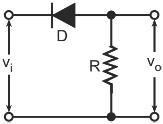
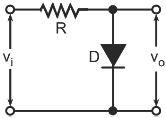
  • Figure below shows a basic diode-based clipper circuit. If a sinusoidal input is applied to the circuit, plot the output waveform. Assume the diode to be ideal.

    Diode-based clipper circuit

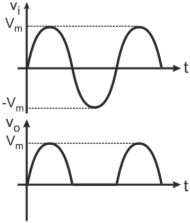
    Given that the diode is ideal, therefore the cut-in voltage of the diode is zero. Figure below shows the input (sinusoidal) and the output waveforms for the given clipper circuit. The circuit configuration is similar to that of a half-wave rectifier circuit. During the positive half cycle of the input waveform, the diode is forward-biased and during the negative half cycle of the input waveform, it is reverse-biased. Therefore, the positive half cycles therefore appear across the output.

    Input and output waveforms for the clipper circuit of Q2 assuming ideal diode

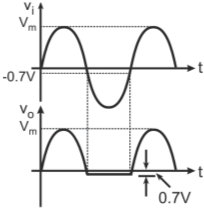
  • For the circuit in Q2, if the diode is a non-ideal Silicon diode, then what is the output waveform for a given sinusoidal input waveform?

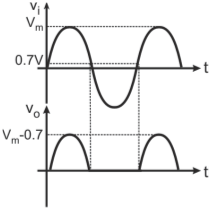
    Figure below shows the input-output waveforms for the circuit in Q2 assuming that the diode is a non-ideal Silicon diode.

    Input and output waveforms for clipper circuit of Q2 assuming non-ideal Si diode

    Silicon diode has a cut-in voltage of 0.7V. Therefore, the diode starts conducting when its voltage reaches 0.7V. If the diode is Germanium, then a cut-in voltage of 0.3V is taken.

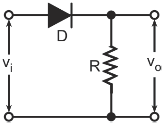
  • Figure below shows a basic diode-based clipper circuit.

    If a sinusoidal input is applied to the circuit, plot the output waveform. Assume the diode to be ideal.

    Diode-based clipper circuit

    Given that the diode is ideal, therefore the cut-in voltage of the diode is zero. Figure below shows the input (sinusoidal) and the output waveforms for the given clipper circuit. The circuit is a half-wave rectifier circuit that allows negative half cycles to appear across the output. The diode in this case is forward-biased during negative half cycles of the input waveform.

    Input and output waveforms for the clipper circuit of Q4 assuming ideal diode

  • For the circuit in Q4, if the diode is a non-ideal Silicon diode, then what is the output waveform for a given sinusoidal input waveform?

    Figure below shows the input-output waveforms for the circuit in Q4 assuming that the diode is a non-ideal Silicon diode. Silicon diode has a cut-in voltage of 0.7V. Therefore, the diode starts conducting when its voltage reaches 0.7V. If the diode is Germanium, then a cut-in voltage of 0.3V is taken.

    Input and output waveforms for clipper circuit of Q4 assuming non-ideal Si diode

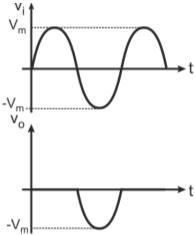
  • Figure below shows a basic diode-based clipper circuit.

    If a sinusoidal input is applied to the circuit, plot the output waveform. Assume the diode to be ideal.

    Diode-based clipper circuit

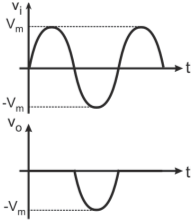
    Given that the diode is ideal, therefore the cut-in voltage of the diode is zero. Figure below shows the input (sinusoidal) and the output waveforms for the given clipper circuit.

    Input and output waveforms for the clipper circuit of Q5 assuming ideal diode

    The diode is forward-biased during positive half cycles and reverse-biased during negative half cycles. The output is therefore clipped to zero during positive half cycles and the negative half cycles are allowed to appear across the output as the diode is then reverse-biased.

  • For the circuit in Q7, if the diode is a non-ideal Silicon diode, then what is the output waveform for a given sinusoidal input waveform?

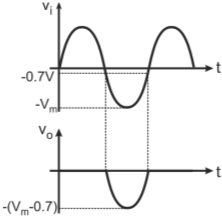
    Figure below shows the input-output waveforms for the circuit in Q7 assuming that the diode is a non-ideal Silicon diode. Silicon diode has a cut-in voltage of 0.7V. Therefore, the diode starts conducting when its voltage reaches 0.7V. If the diode is Germanium, then a cut-in voltage of 0.3V is taken.

    Input and output waveforms for clipper circuit of Q7 assuming non-ideal Si diode

Got a voltage spike of curiosity?

Send your doubts now!